so on 4chan the word “wapanese” was used to refer to dumb anime nerds. white boy wannabe japanese. makes sense.
A mod got pissed at it being used so much and said that the next person to use it would get banned, so the boards decided to use a silly nonsense word to replace it.
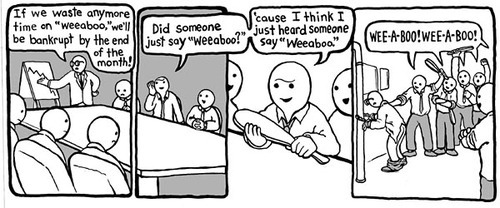
by complete general consensus, the boards picked the word “weeaboo” from a perry bible comic.
henceforth, “weeaboo” was used in replacement of “wapanese”.
the end.
I have learned so much
this should be taught in history class
An object lesson in how attempting to censor words always fails.
La pomme d’eau. La pomme de terre. Le pomme de feu. La pomme d’air. Il y a très longtemps ces quatre patates vivaient en harmonie. Mais un jour, la pomme du feu décida de passer à l’attaque.
i don’t even fucking speak french but I fucking know what that last comment says
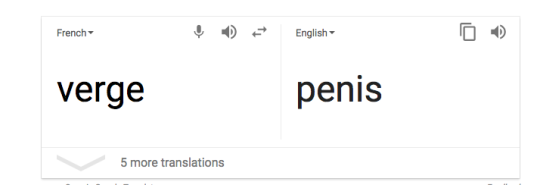
@indigopersei is the french language just always on the verge of getting someone accused of assault or..?
my friend, if only you knew
It’s a very dangerous language to learn
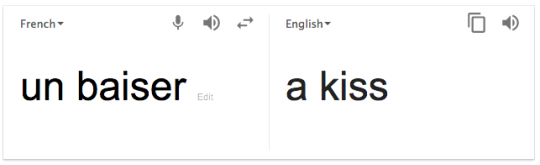
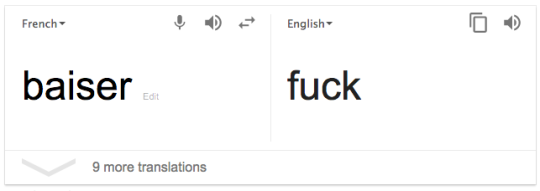
Here’s an interesting thing about French! Everything needs to have an article in front of it. That’s why it’s “la chat” as opposed to just “chat”. So, for instance, you could say la fille for the girl, or jeune fille for young girl, but you can’t just say fille, because that means you are calling her a sex worker in a derogatory way.
The moral of the story is, if you want to make something rude in French, just take out the article in front of it. Yes, this works for nearly. every. word.
Every year. Every year there’s that kid who forgets that you can’t translate “I am excited” to “Je suis excitée”. And every year Monsieur Jordan has to slam the brakes before that kid can finish his sentence and then tactfully ask him not to announce to the class that he is horny.
“is the french language always on the verge” oh buddy, oh pal, i am so happy to break this news to you:
the asl sign for “transgender“ is basically the same as the sign for ”beautiful“ but signed at the chest instead of in front of the face.
so that’s cool.
this is my imperfect not-a-fluent-signer understanding but:
(based on a presentation by a deaf trans guy i was at in 2005 where he was promoting that sign)
it seems like that sign was invented and implemented by trans people over the last 10-ish years. before that the predominant vocabulary was “sex change” and then some deaf trans people were like “yo fuck that” and came up with the current sign, which starts off with the sign for “myself,” then motion that indicates both change and coming together, and ends with the closed hand held against the sternum.
and in the process it also mimics the sign for “beautiful”
and because of spatial grammar, things closer to the front of your body in ASL are generally more vital, more emphatic, more immediate, more present.
so it’s actually a case where the word coherently indicates “beauty” and “self transformation” and contains hints of the complete thought of “my self transforming, through a coming together of disparate factors, into something more real, immediate, and vital than I was before.”
so yeah. that’s just fuckin’ awesome.
and that’s just the way to express that concept now.
Meanwhile, “utter” works for the first (e.g., “you utter floorboard”) but somehow “utterly” doesn’t seem to work as well for the second (“I was utterly floorboarded”).
Utterly doesn’t work for drunk because it’s the affix for turning random objects into terms for *shocked*, obviously.
… huh. I thought that might just be the similarity to “floored”, and yet “I was utterly coat hangered” does seem to convey something similar.
I have to tell you, I am utterly sandwiched at this discovery.
Completely makes the phrase mean “super tired”.
“God, it’s been a long week, I am completely coat-hangered.”
old people really need to learn how to text accurately to the mood they’re trying to represent like my boss texted me wondering when my semester is over so she can start scheduling me more hours and i was like my finals are done the 15th! And she texts back “Yay for you….” how the fuck am i supposed to interpret that besides passive aggressive
Someone needs to do a linguistic study on people over 50 and how they use the ellipsis. It’s FASCINATING. I never know the mood they’re trying to convey.
I actually thought for a long time that texting just made my mother cranky. But then I watched my sister send her a funny text, and my mother was laughing her ass off. But her actual texted response?
“Ha… right.”
Like, she had actual goddamn tears in her eyes, and that was what she considered an appropriate reply to the joke.I just marvelled for a minute like ‘what the actual hell?’ and eventually asked my mom a few questions. I didn’t want to make her feel defensive or self-conscious or anything, it just kind of blew my mind, and I wanted to know what she was thinking.
Turns out that she’s using the ellipsis the same way I would use a dash, and also to create ‘more space between words’ because it ‘just looks better to her’. Also, that I tend to perceive an ellipsis as an innate ‘downswing’, sort of like the opposite of the upswing you get when you ask a question, but she doesn’t. And that she never uses exclamation marks, because all her teachers basically drilled it into her that exclamation marks were horrible things that made you sound stupid and/or aggressive.
So whereas I might sent a response that looked something like:
“Yay! That sounds great – where are we meeting?”
My mother, whilst meaning the exact same thing, would go:
‘Yay. That sounds great… where are we meeting?”
And when I look at both of those texts, mine reads like ‘happy/approval’ to my eye, whereas my mother’s looks flat. Positive phrasing delivered in a completely flat tone of voice is almost always sarcastic when spoken aloud, so written down, it looks sarcastic or passive-aggressive.
On the reverse, my mother thinks my texts look, in her words, ‘ditzy’ and ‘loud’. She actually expressed confusion, because she knows I write and she thinks that I write well when I’m constructing prose, and she, apparently, could never understand why I ‘wrote like an airhead who never learned proper English’ in all my texts. It led to an interesting discussion on conversational text. Texting and text-based chatting are, relatively, still pretty new, and my mother’s generation by and large didn’t grow up writing things down in real-time conversations. The closest equivalent would be passing notes in class, and that almost never went on for as long as a text conversation might. But letters had been largely supplanted by telephones at that point, so ‘conversational writing’ was not a thing she had to master.
So whereas people around my age or younger tend to text like we’re scripting our own dialogue and need to convey the right intonations, my mom writes her texts like she’s expecting her Eighth grade English teacher to come and mark them in red pen. She has learned that proper punctuation and mistakes are more acceptable, but when she considers putting effort into how she’s writing, it’s always the lines of making it more formal or technically correct, and not along the lines of ‘how would this sound if you said it out loud?’




 Solutions Without Problems